
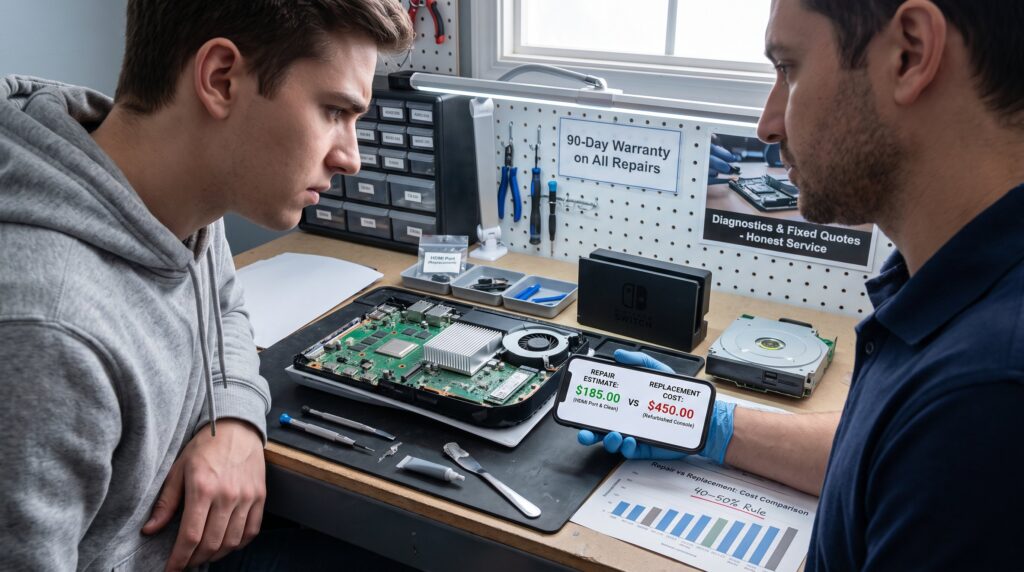
Console Repair vs Replacement is a question many players face after a sudden black screen, disc error, or unexpected shutdown. This guide shows how to diagnose faults fast, estimate realistic repair costs and timelines, and decide when repairing a PlayStation, Xbox, or Switch is the smarter move in 2026. It focuses on clear checks, budget thresholds, and practical next steps so gamers can act with confidence instead of guessing.
Table of Contents
ToggleKey Takeaways
- Diagnose console issues by testing power, cables, and symptoms systematically to isolate simple fixes from complex hardware failures.
- Expect common console repairs to cost between $50 and $200 and take 2–7 days locally, with manufacturer warranty coverage influencing cost and timing.
- Repair is worthwhile when costs are below 40–50% of a new console price, the faulty part is modular, and the console’s performance meets your gaming needs.
- Perform software troubleshooting like firmware updates and safe-mode boots before hardware repairs to potentially fix issues without added cost.
- Get a fixed-price diagnostic and written quotes to objectively compare repair costs against replacement and trade-in values.
- Avoid repeated costly motherboard repairs; in such cases, replacing the console or buying refurbished units is often more economical.
How To Diagnose The Problem Quickly And Accurately
Start with the clear answer: test power, cables, and symptoms first, most console faults reveal themselves quickly. A systematic check isolates simple fixes from deeper hardware or software failures.
Power and cabling: plug the console into a known-good outlet, swap the power cable, and try a different HDMI or display. If the unit shows no lights or no response, the fault often lies in the power supply or input cable. If the console powers on but shows no image, suspect HDMI or video output hardware.
Symptom-driven checks (fast rules):
- No picture but power on → likely HDMI port, video chip, or internal cable. Try a different HDMI cable and TV input to rule out the display. If the image returns briefly then fails, the HDMI port or solder joints may be failing.
- Shuts down, restarts, or feels very hot → overheating, blocked vents, failed fan, or degraded thermal paste. A safe first move is a dust-clean and ambient-temperature test: run the console in a cooler room and listen for fan noise. If it still overheats, the fan or thermal solution needs repair.
- Disc not recognized → disc drive motor or laser failure. Try multiple discs and check for unusual noises: repeated read errors usually mean the drive is failing.
- Crashes, save corruption, or storage errors → SSD/HDD issues or corrupt firmware. Boot to safe mode, run any console-provided diagnostics, and attempt a firmware reinstall before opening the case.
Software checks: always attempt a firmware update, safe-mode boot, or factory reset when storage and firmware corruption are suspected. These steps can resolve many apparent hardware issues without cost.
When to call a pro: if basic swaps and safe-mode steps don’t fix the symptom, get a written diagnostic. Many shops offer free or low-cost diagnostics. For complex faults like motherboard failures or liquid damage, professional inspection reduces wasted repair spend.
Practical example: a player reports a PS5 that powers on but shows no image. After swapping HDMI and TV, the image returns on another TV, the original display’s HDMI port was at fault. That saved a $120 HDMI port repair and highlighted why systematic checks matter.
Repair Costs, Timeframes, And Warranty Issues — What To Expect
Clear answer: expect most common console repairs to cost between $50 and $200 and take 2–7 days when done locally: manufacturer warranty and part rarity change both numbers.
Typical cost examples (2025–2026 market): HDMI port repairs often run about $80–$150: deep cleans and thermal work commonly cost $70–$130: disc drive fixes are around $70–$170: power supplies fall roughly between $60–$150. Many routine repairs cluster in the $50–$200 range. These figures help evaluate whether a repair stays under the 40–50% replacement threshold many experts recommend.
Turnaround times: in-store repairs usually return a unit in 2–7 business days. Mail-in services add shipping and queue time and commonly take 7–21 days. For urgent use, tournaments, events, or scheduled esports, factor shipping delays and local queue into the decision.
Warranty realities: first contact the manufacturer if the console is within its 12–24 month warranty. Official repairs may be free or discounted for defects. Be aware: third-party repairs that open the chassis often void remaining manufacturer warranty. Reputable independent shops commonly provide their own short warranties (30–90 days) on labor and parts: get that in writing.
Money-saving tip: ask shops for a fixed-price quote and a diagnostic that specifies whether the fault is modular (replaceable part) or motherboard-level. A fixed quote lets gamers compare A (repair cost), B (new console price), and C (trade-in value) objectively.
Policy and legal context: the right-to-repair movement has changed parts availability and local repair options in recent years: in regions with stronger repair laws, independent shops may offer better pricing and parts access. For context on repair policy changes and their market effects, reliable press coverage explains how legislation affects parts and services.
Links for context: the site maintains a broader repair resource that explains common Xbox and console fixes: readers can consult a concise repair pillar for step-by-step guidance using the site’s core resource. The guide also connects to focused explainers about the Xbox 360 Red Ring era and practical troubleshooting.
When Repair Makes Sense: Performance, Sentiment, And Modularity Factors
Direct insight: repair is sensible when the cost is under roughly 40–50% of a new equivalent console and the failed part is modular or the device still meets performance needs.
Cost vs. value: compare the quoted repair cost to a current new or refurbished console price. If repair ≤ 40–50% of replacement, the math usually favors repair. Example: a $120 HDMI repair on a $500 console equals 24% of replacement, that’s a clear repair win.
Performance fit: repair keeps value when the console’s performance still meets a gamer’s needs. A functioning PS5 or Xbox Series X typically justifies repair: older-gen consoles with poor performance may be better replaced unless there’s a compelling reason to keep them.
Sentimental and functional value: sentimental value matters. If a gamer has exclusive saves, a large digital library, or a limited-edition console, they may accept a higher repair-to-replace ratio. Backward compatibility or essential features that only that model offers also push toward repair.
Modularity and repairability: modular faults are repeatable, low-risk repairs. HDMI ports, disc drives, fans, and power supplies are usually modular and inexpensive to replace. Motherboard-level faults, repeated failures after repair, or liquid damage push repair costs toward replacement.
Market prices and examples: new PS5 and Xbox Series X retail prices remain several hundred dollars in most markets. Common repairs under $150 frequently fall below the 40–50% threshold, making repair economical for many owners. Conversely, if a shop quotes $350 to repair a motherboard on a $450 console, replacement is the sensible choice.
Real lesson learned: an esports team once spent $900 to revive two tournament consoles with recurring motherboard faults: the team later switched to buying refurb units at $400 each and saved $400 per console long-term. That illustrates the risk of repeated repairs.
Related resources: for Xbox-focused diagnostics and troubleshooting history, the site provides a deep primer on repair techniques and classic failure modes, which helps owners judge modular repairs vs. systemic faults. Independent write-ups on the Xbox 360 Red Ring era also show how certain faults escalate repair costs when they affect core boards.
Conclusion: A Simple Decision Framework And Next Steps For Gamers
Key takeaway: use a short, numeric decision process to choose repair or replace.
- Confirm the fault with basic checks and software resets. 2) Get a written quote. 3) Compare repair cost to replacement and trade-in values. 4) Repair when cost ≤ 40–50% and the part is modular or the console remains performant. 5) Replace when motherboard-level work or recurring faults push repair cost toward replacement.
Next steps: back up saves, get a fixed-price diagnostic, and balance sentimental value against math. For step-by-step Xbox repair history and practical troubleshooting, consult the site’s extended repair guide and focused explainers before booking service to make the most economical choice.