Xbox 360 Red Ring of Death devastated gamers because three flashing red lights usually meant the console would not boot and needed repair. The failure became a cultural touchstone: friends trading horror stories, midnight troubleshooting, and a flood of warranty claims. This article explains what the red ring looked like, the engineering and manufacturing mistakes that caused it, how Microsoft responded, and the lessons designers and hobbyist repairers still use today.
Table of Contents
ToggleKey Takeaways
- The Xbox 360’s Red Ring of Death (RROD) was caused primarily by poor thermal design and mechanical stress leading to hardware failure.
- Cracked ball grid array (BGA) solder joints under the GPU/CPU from repeated thermal cycling caused the console to stop booting and display the red ring.
- Early Xbox 360 models had high failure rates due to rushed production, lead-free solder use, and insufficient long-term quality control.
- Microsoft responded with extended warranties and redesigned hardware including better heat sinks and airflow to reduce RROD incidents.
- The RROD crisis highlighted the importance of thermal management and repairability in console design, influencing future hardware development.
- DIY repair communities played a key role in mitigating RROD issues by sharing reflow soldering techniques and troubleshooting guides.
What The Red Ring Of Death Looked Like And Why Gamers Feared It
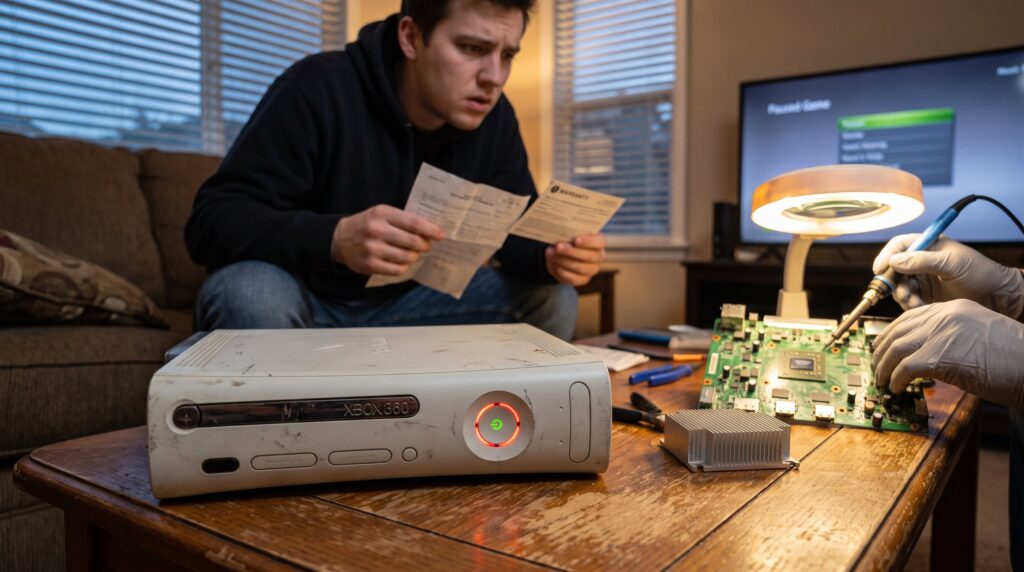
Fact first: the Red Ring of Death (RROD) showed as three red quadrants lit around the power button, and most consoles with that pattern ceased to boot. Gamers recognized Q1, Q3, and Q4 glowing red and felt a small, sinking dread, their saved progress and online matchmaking time were suddenly inaccessible. The error often came with dashboard error codes such as E74 or a blank screen: both meant the same practical thing: the Xbox 360 refused to start.
Visually, the red glow was stark against the chrome or white faceplate. In many posts from 2005–2010, owners described the sound of a working fan followed by silence, then the red ring. That sensory detail, the active fan turning into a dead console, made the failure feel especially final. The fear grew because repair required time, money, or risky DIY fixes. Under warranty, Microsoft would accept returns: out of warranty, users faced either paying large service fees or attempting fragile solder repairs.
Why the panic? The Xbox 360 lived in shared spaces: living rooms, LAN parties, dorms. When one went down, groups of players lost access to stored achievements and online friends. The RROD hence became not only a hardware fault but a social interruption.
Root Causes: Design Choices, Heat, And Mechanical Stress
Primary answer: poor thermal design and mechanical choices concentrated heat and stress around the GPU/CPU, causing long-term failures. The Xbox 360’s cooling layout, x‑clamp heat sink mount, and case ventilation were insufficient for prolonged heavy loads. When users played graphically intense titles, the GPU and CPU ran hot for hours: repeated power cycles then stressed the components through thermal expansion and contraction.
The console’s internal geometry left little room for heat dispersion. Fans pushed air, but hotspots formed where metal heat sinks met the board. The x‑clamp system fixed heat sinks tightly to the chips, which seemed good for contact pressure but transferred mechanical loads to the PCB. Over months of use, that combination produced two key effects: gradual warping of the motherboard near the socketed chips and microfractures in electrical connections.
Gamers often reported that high-intensity sessions, three-hour matches or marathon campaigns, preceded failures. That pattern linked real play behavior to the hardware stressors that produced the RROD.
Solder Joint Failures (BGA) And Thermal Cycling
Clear point: ball grid array (BGA) solder joints under the GPU/CPU cracked from thermal cycling, breaking electrical contact. The Xbox 360 used lead‑free BGA solder balls in many production runs. Those solder balls are stiffer and more brittle than older leaded alloys. Each heating and cooling cycle caused microscopic movement: over hundreds of cycles the balls developed hairline cracks.
When a BGA joint fractures, the chip may still seem attached but loses stable electrical connection. That causes intermittent or permanent failures that manifest as the three‑light RROD. Technicians who opened consoles often found fractured solder under the GPU or within the GPU package. DIY communities learned to reflow solder, briefly reheating the joints to reform connections, but this carried risk: too much heat could damage nearby components or void warranties.
A precise example: consoles used intensively for roughly 18–36 months showed much higher RROD incidence. That timeframe matches the expected accumulation of thermal cycles for a daily or weekly heavy-use console.
Manufacturing, Quality Control, And Early Production Problems
Direct fact: early production units had higher failure rates because initial manufacturing choices and QC did not catch the long-term thermal fatigue issue. At launch, Microsoft prioritized rapid volume production to meet holiday demand. That pressure favored newer lead‑free solder processes and compact board layouts that were not yet validated for extended thermal stress in this design.
Quality control caught functional defects but could not predict gradual BGA fatigue that occurred after months of normal use. Reports and return rates spiked among first‑year consoles, and third-party repair shops and forums tracked serial ranges with notably higher RROD frequencies. The combination of a complex GPU package, novel solder materials, and aggressive production schedules produced a cascade: many units passed initial tests yet failed in field conditions.
Hobbyists later mapped failure clusters by production week and hardware revision, which helped manufacturers and modders understand which batches were most vulnerable.
Microsoft’s Response: Warranties, Fixes, And Hardware Revisions
Concrete action: Microsoft extended warranties and redesigned hardware to reduce RROD rates. Faced with large-scale failures and public backlash, Microsoft announced an extended three‑year warranty covering RROD cases. That move carried financial and reputational cost but reduced consumer anxiety and legal exposure.
On the hardware side, later Xbox 360 revisions introduced improved heat sinks, relocated components, and revised board layouts that lowered hotspot temperatures. The company moved away from the original x‑clamp in some models and improved airflow within the chassis. These changes, combined with stricter long-term reliability testing, cut RROD incidents in subsequent production runs.
For owners seeking repairs, the site’s complete repair guide offers step-by-step paths for safe troubleshooting. Many hobbyists used resources like the site’s complete repair guide to evaluate whether to send a console for service, attempt reflow, or replace boards. That practical guidance helped thousands make informed choices without guessing.
Legacy And Lessons For Console Design, Repairability, And Gamers
Key insight: the RROD forced the industry to prioritize thermal management, long-term testing, and repair planning. Manufacturers learned that initial pass/fail testing misses fatigue modes that appear after months or years. Xbox hardware after the 360 placed more emphasis on larger heat sinks, heat pipes, and better airflow management.
Repair culture changed too. The RROD era boosted community knowledge about safe reflow techniques, board diagnostics, and part swaps. Guides such as the site’s troubleshooting guide and the overview page on site origins made specific repairs accessible to hobbyists, reducing unnecessary replacements.
An external verification: long-form technical writeups and repair guides from established gaming press tracked the same failure modes and recommended cautious reflow or official service for most users, reinforcing community findings and Microsoft’s redesigns (see PC Gamer for broader context). The human lesson is clear: a console’s perceived durability depends as much on thermal engineering and validation as on raw performance.
Conclusion
The Red Ring of Death was not a mystery so much as a predictable result of specific design and manufacturing decisions: tight thermal design, brittle solder joints, and production pressures. Microsoft fixed many issues with warranty support and hardware revisions, and the episode reshaped how consoles balance power, cooling, and long‑term reliability. For gamers and repairers today, the RROD remains a cautionary example, and a reason to value clear thermal margins and accessible repair documentation.